Hidden in the Archives Research
Article published in Context 46, Summer 2024/2025, Journal of the Costume and Textile New Zealand [CTANZ]
From the Collection: Research Joy to the Realities of Translation into Costume Creations – an Eighteenth-Century Shirt.
By Anna Deacon, Research Associate, Tāmaki Paenga Hira Auckland War Memorial Museum
Following an international career as a costume pattern drafter and tailor for the past 25 years and associated adventures in film, TV, and theatre, covering all genres and eras, in 2022 I undertook a Masters in Historical Costume, via correspondence, at the Arts University in Bournemouth. The depth of my research into 18 artefacts (and counting) resulted in a thesis titled ‘Hidden in the Archives; Heirloom Textiles of Tamaki Paenga Hira Auckland War Memorial Museum’. It prompted a 2023 application for a Geoffrey Squire Memorial Bursary from the Costume and Textiles Association in the United Kingdom, which I was awarded, and which provided a substantial research grant.1 This research has, in turn, led to the invitation to become a research associate with the Tāmaki Paenga Hira AWMM, as well as a collaboration with Curator Jane Groufsky to write and publish a book entitled Heirloom Textiles.
This particular story begins with a garment from the Human History collections at Tāmaki Paenga Hira AWMM where a significant moment of research joy came from studying this old ‘crinkled’ shirt. [fig 1]
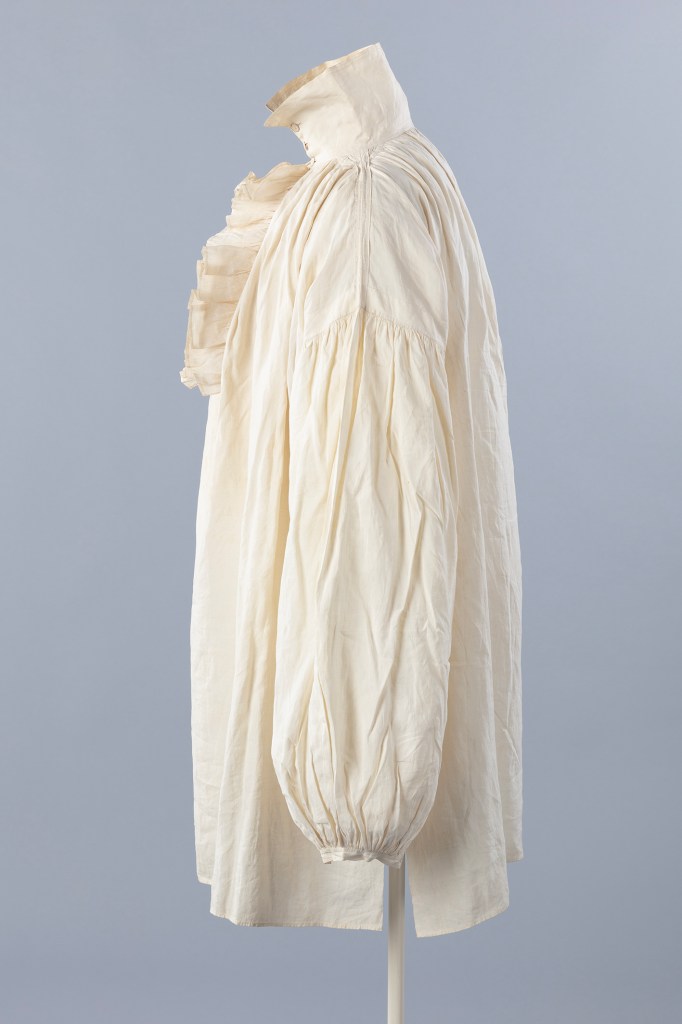
Auckland Museum col.0989 [Image—Auckland Museum]3
.
The museum records have a simple description of this shirt: “Gentleman’s morning shirt; wide sleeves and narrow cuff bands; said to have come from the ‘Stevens’ family, Dean of Winchester; tiny cross stitch laundry marker.” Museum records can be misleading or riddled with errors, though they often hold just enough clues to dig deeper and unravel a past history. Establishing a direct connection between the donor and the documented original owner for provenance is essential. These days, researching the ancestral family tree is a much easier process with the likes of ancestry.com and other similar sites, including National Archives, which provide access to scanned historical records from Parish Births/Marriages and Deaths, Census and Voter lists, Military records, Immigration and Emigration Records to name but a few resources available to cross reference
facts. In this case, contact was made with Winchester Cathedral to confirm if any ‘Stevens’ had been Deans. David Rymill, Winchester Cathedral archivist, replied confirming only one, Very Revd William Richard Wood Stephens (1839–1902)4 , Dean, 1895–1902 [note the alternative spelling to museum records] and kindly supplied a photograph they had on file, satisfying my curiosity regarding ecclesiastical attire of the time. Evident from the image. [fig 2]
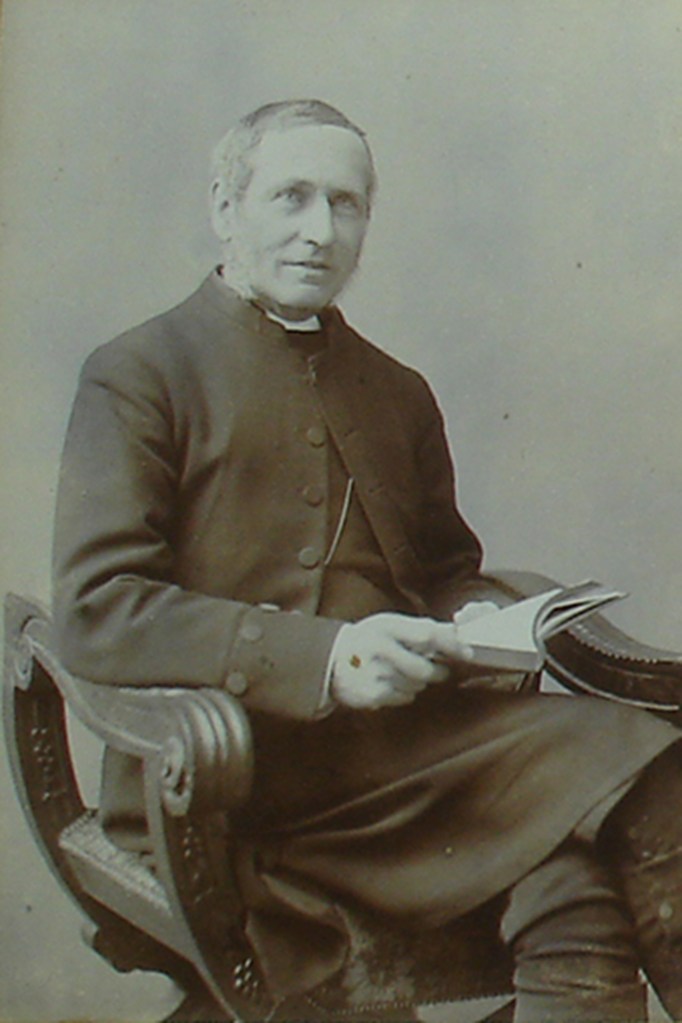
[Image—Winchester Cathedral]
Reverend Stephens’ outfit is sombre and refined; it reflects that of end- of-the-nineteenth-century cut and fit. It is not the kind of attire that such a flamboyant earlier-period shirt would have been worn underneath. This led to an investigation into older generations of the Stephens family. Ancestry records connect the donor Cora Milne Gow directly with this Dean William Richard Wood Stephens, son of Charles Stephens (1790–1867) and Catherine Wood (1800–1875). In the 1851 census, Charles is recorded as a banker and magistrate who died, leaving considerable effects valued at under £90,000 in his will. Therefore, the shirt may have belonged to William’s father Charles, with the attire of people in official roles such as judiciary and banking often retaining echoes of fashions observed in earlier periods. Dean William Stephens and his wife Charlotte Jane Hook (1844–1919)5 had four children, three girls, and their son Charles Hook Stephens (1874–1944)6, who was a singing teacher. At age 42, this Charles Stephens is listed in English incoming passenger lists from New Zealand as having left Wellington on 22nd June 1916, with his wife Ina Winifred Gow (1886–1960)7, also a music teacher, aged 29, onboard the RMS Remuera8 which arrived in London in August 1916. This was the inaugural voyage of the first New Zealand Shipping Company vessel to pass through the Panama Canal. Ina was born in Greymouth, New Zealand, and had married Charles H.Stephens in 1913 in Wellington, so we can only presume he had travelled previously to Aotearoa or Ina to England. The shirt in question must have travelled with them or visiting family members and has remained in New Zealand. It was Ina’s sister Cora who donated the shirt to the museum circa 1965.
Of course, one more ancestor requires identification: Dean William Stephens’s grandfather, William Stephens (1751–1829)9, who was the father of the banker and judge Charles Stephens, and significantly was a gentleman who left an extensive will. It is this William Stephens who is the most likely candidate from the Stephens family to have been the original shirt owner. His will and additional resources through the West Berkshire and Royal Berkshire Archives10 confirm that William Stephens (1751–1829) and his brother Robert had inherited a brewery called The Booth at Aldermaston Wharf and land from their father, also William Stephens the elder of Mortimer (–1780)11. In 1830, it was inherited within the family again by sons William (1783–1856), John (1785–) and Charles (1790–1867) [father of Dean William Stephens of Winchester Cathedral].
By 1833, when the Aldermaston Brewery and other properties were sold to Thomas Strange, thirteen hostelries (pubs) were included. The ownership and sale indicate where substantial wealth within the Stephens family originated and how such a sophisticated, masterfully tailored shirt, befitting high status, was procured. Garments such as shirts throughout the seventeenth, eighteenth and nineteenth centuries were regarded as an important commodity, according to historical records such as wills and probates, as well as artwork and required insurance. This all reflects the considerable value placed on what we now consider an article of commonplace clothing.
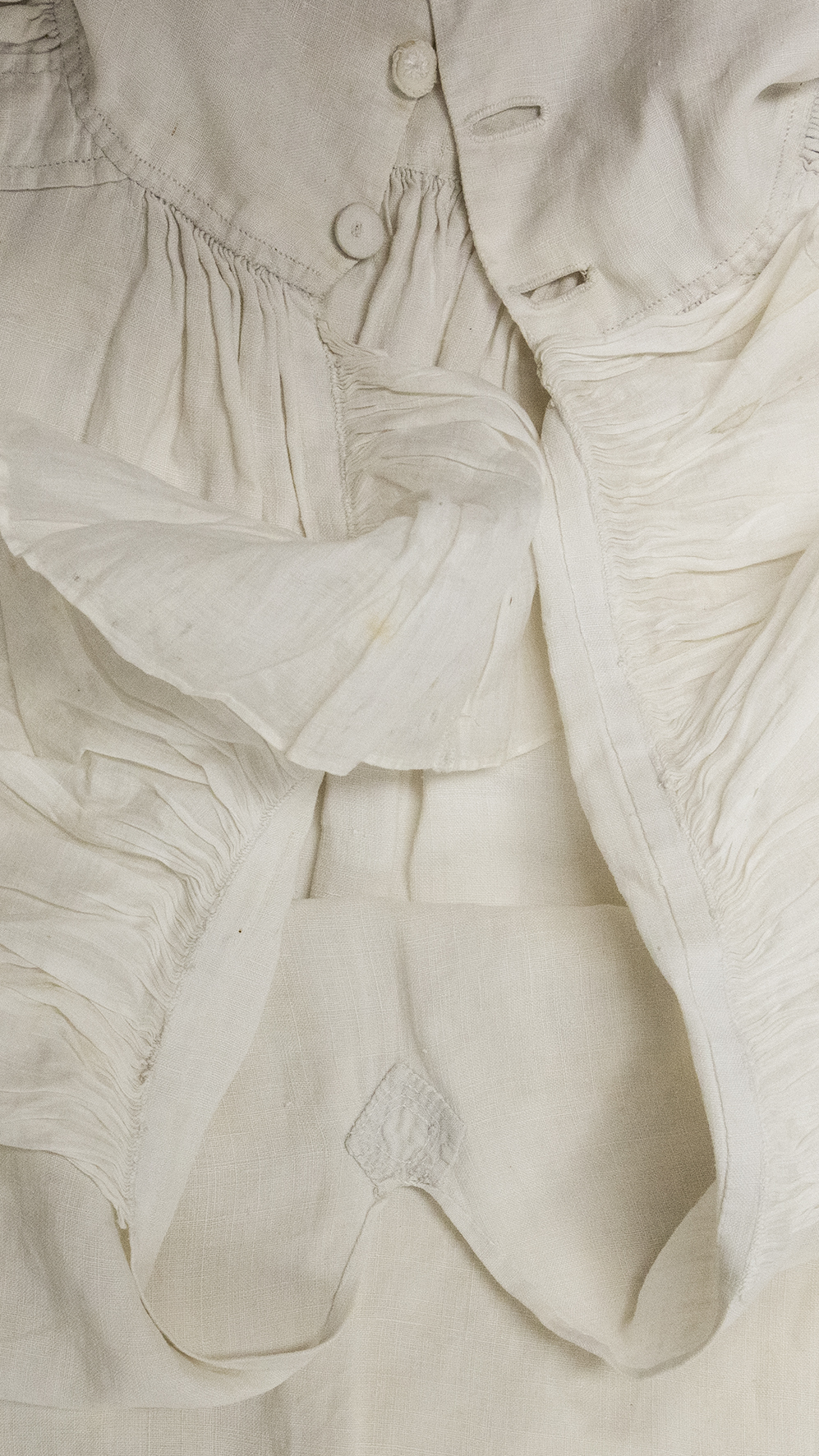
So, physically, what makes this shirt so fascinating? It is an exquisite example of refined garment making within menswear at the turn of the eighteenth/nineteenth centuries. Due to the style and cut of shirts altering very little between the sixteenth and mid-nineteenth centuries, dating can be problematic. Though classed as underwear as it was worn next to the skin. It retains a basic geometrical cut based on a configuration of rectangles, squares and triangles. This makes these shirts the ultimate example of zero-waste pattern cutting. The combination of more minor details assists in establishing a date to this shirt since the basic construction of shirts remained relatively constant. In this case, we have a smaller narrow cuff depth, high standing collar and a very handsome centre front frill in matching fabric, with the body and sleeves still generous in volume. These features all suggest a dating the shirt from the late eighteenth century and early nineteenth century, after the demise of the popular earlier frilled cuffs, but before the early to mid-nineteenth century transitions where cuffs became deeper with rounded corners, and a shirt’s body and sleeves slimmer in fit, and collars evolved from standing to falling or detachable.
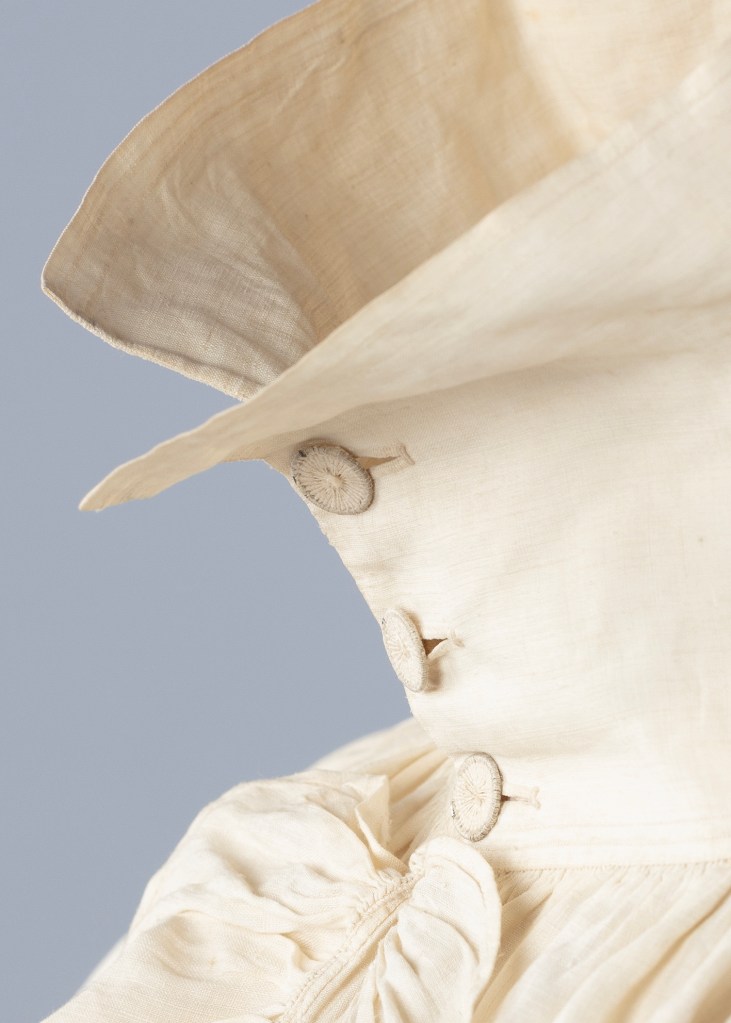
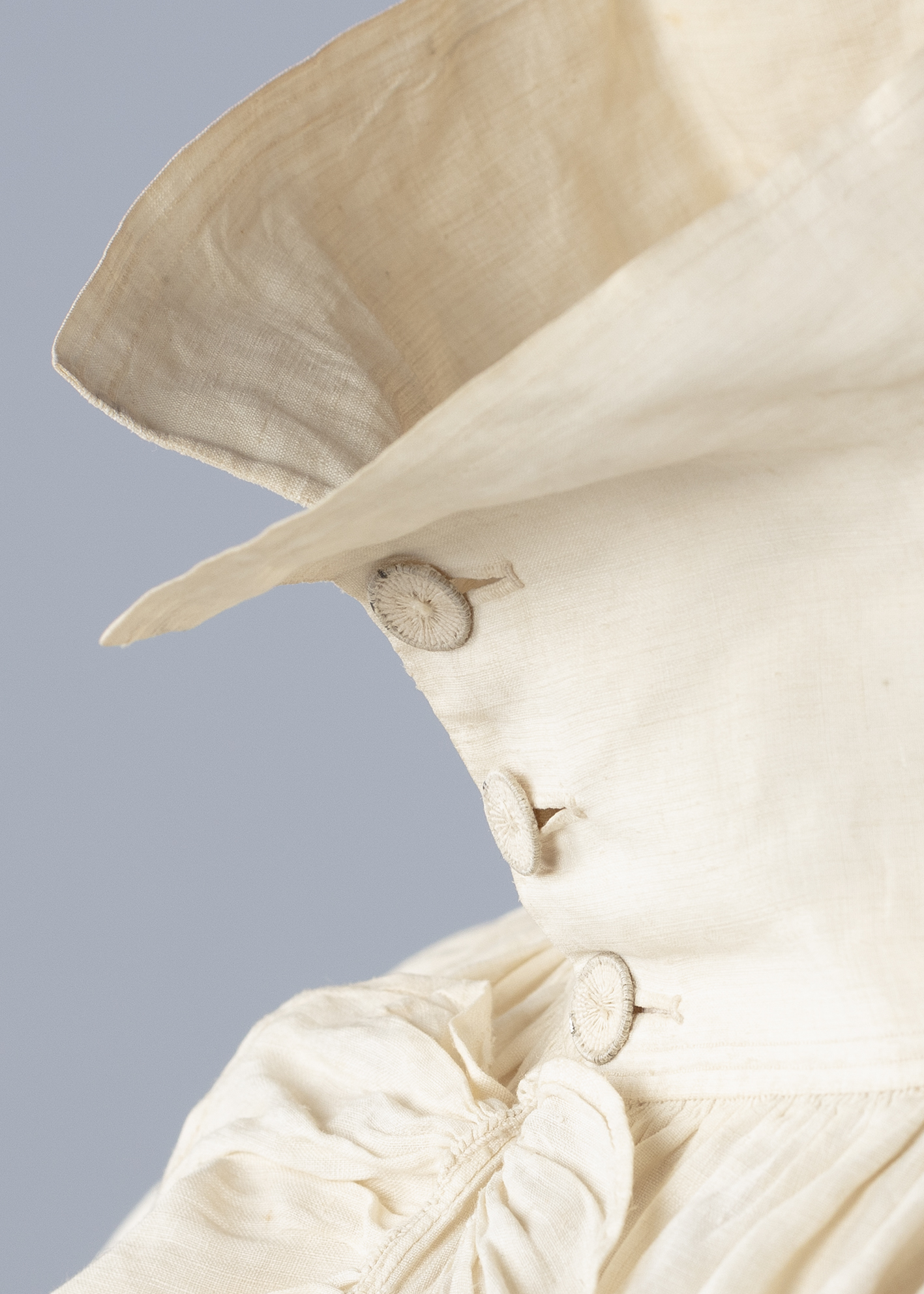
The three decorative Dorset buttons fastened to the collar [fig 3] are another critical element that can assist in dating the Stephens’ shirt. They are 11mm in diameter and uniform in construction, and are constructed of a 1mm thick metal ring with between 36 to 38 spokes woven with a thread to match the main fabric. Dorset buttons originated in the seventeenth century; their creation credited to Abraham Case, a returning soldier who married a local girl from Wardour in Wiltshire in 1622.12 Together, they started the Dorset Button industry in Shaftesbury, where resources were plentiful thanks to the Dorset Horn sheep that roamed the local downs. Case began the creation of buttons using a combination of horn, fabric, and thread. By the 1730s, metal rings made of wire imported from Birmingham replaced horn bases. This cottage industry flourished during the eighteenth century, with the employment of around 700 women and children increasing to around 4,000 in Shaftesbury and 3,000 in neighbouring Blandford by the end of the century. According to McDowell, “it was a popular source of income among the rural poor; a good Buttoner made between six and seven dozen buttons a day and could earn up to 3 shillings.” 13 However, by the turn of the century, this thriving industry had crashed and became another victim of the Industrial Revolution. New, cheaper production methods flooded the market, and fashion tastes changed, making the Dorset button all but redundant by the late 1840s.
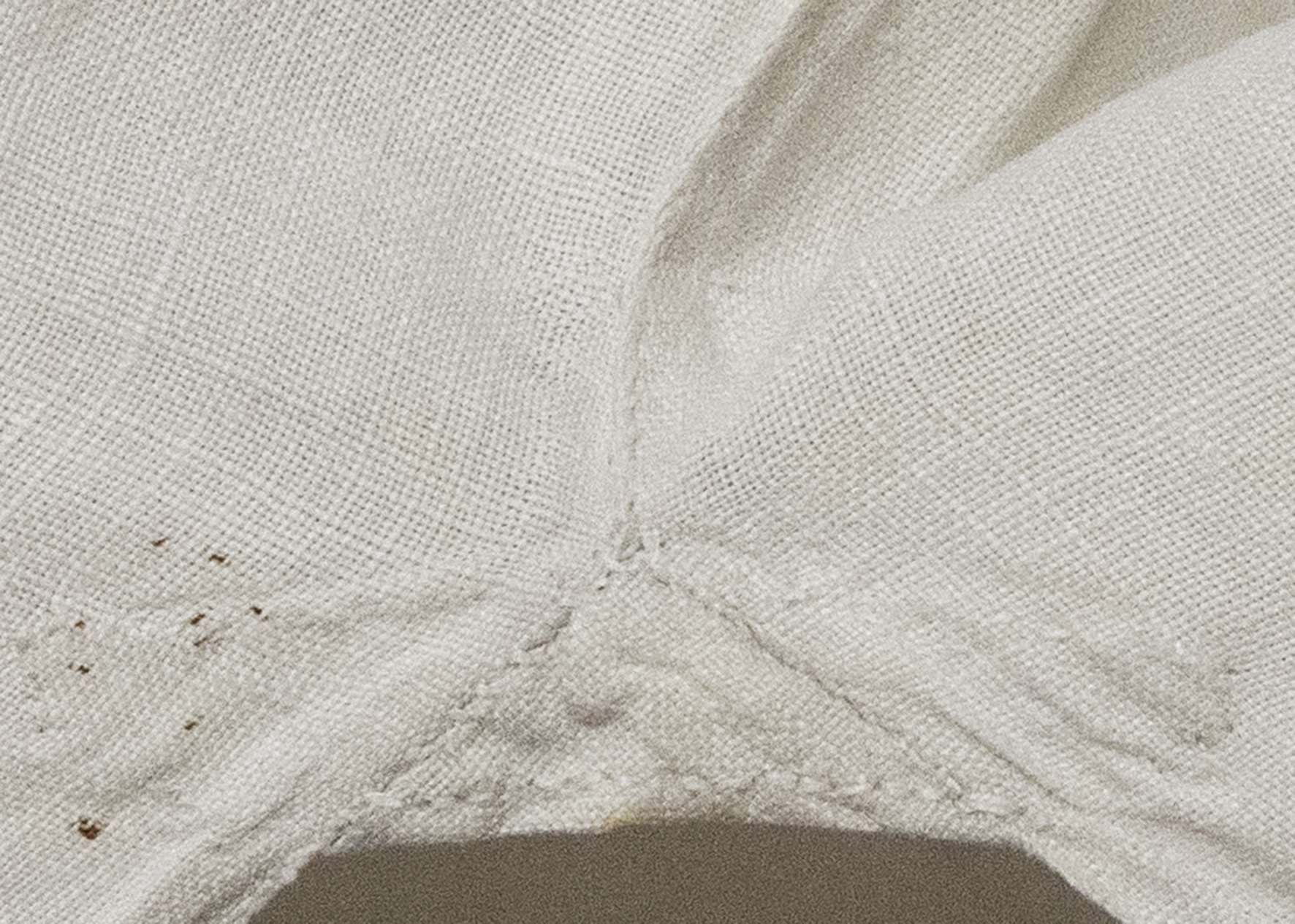
So why did the Stephens’ shirt invoke such a personal fascination for me? I had learned early on in my training as a costume maker that period shirts were commonly French seamed together, and this methodology was one that I have observed as the standard amongst makers throughout Europe and New Zealand. In my experience, working with these shirts involved an in-depth logistical discussion of the complexities of inserting underarm gusset junction points using this seaming technique. This delicate and refined shirt demonstrates an alternative construction methodology that was only possible due to the nature of the linen itself, particularly its narrow width, high-quality weave and tiny selvedge.
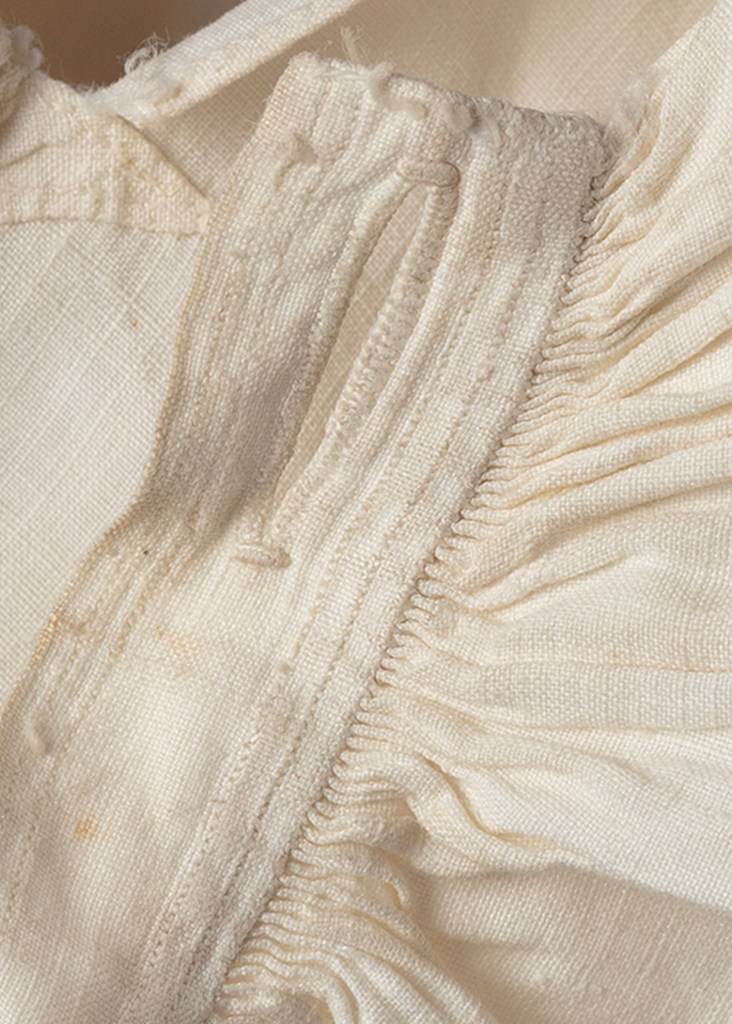
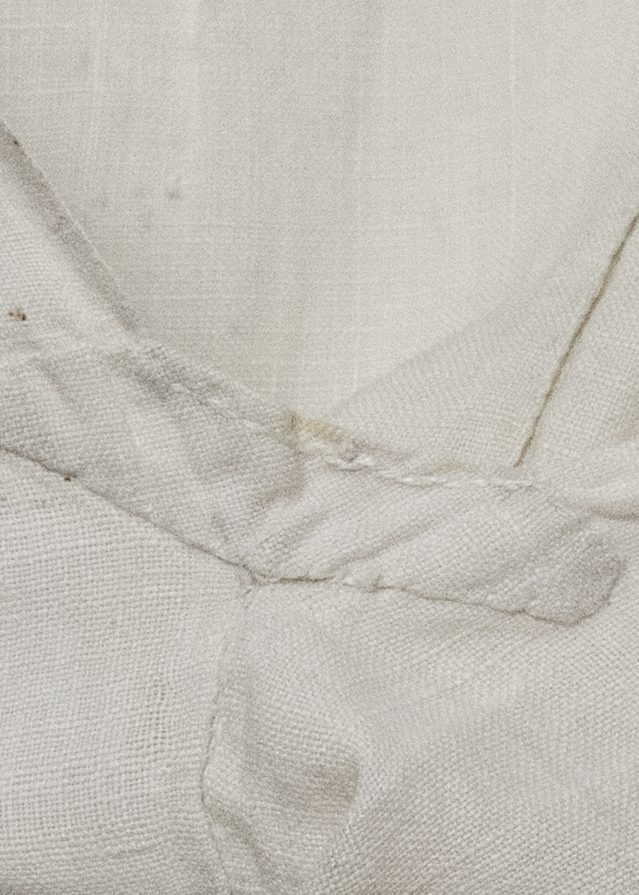
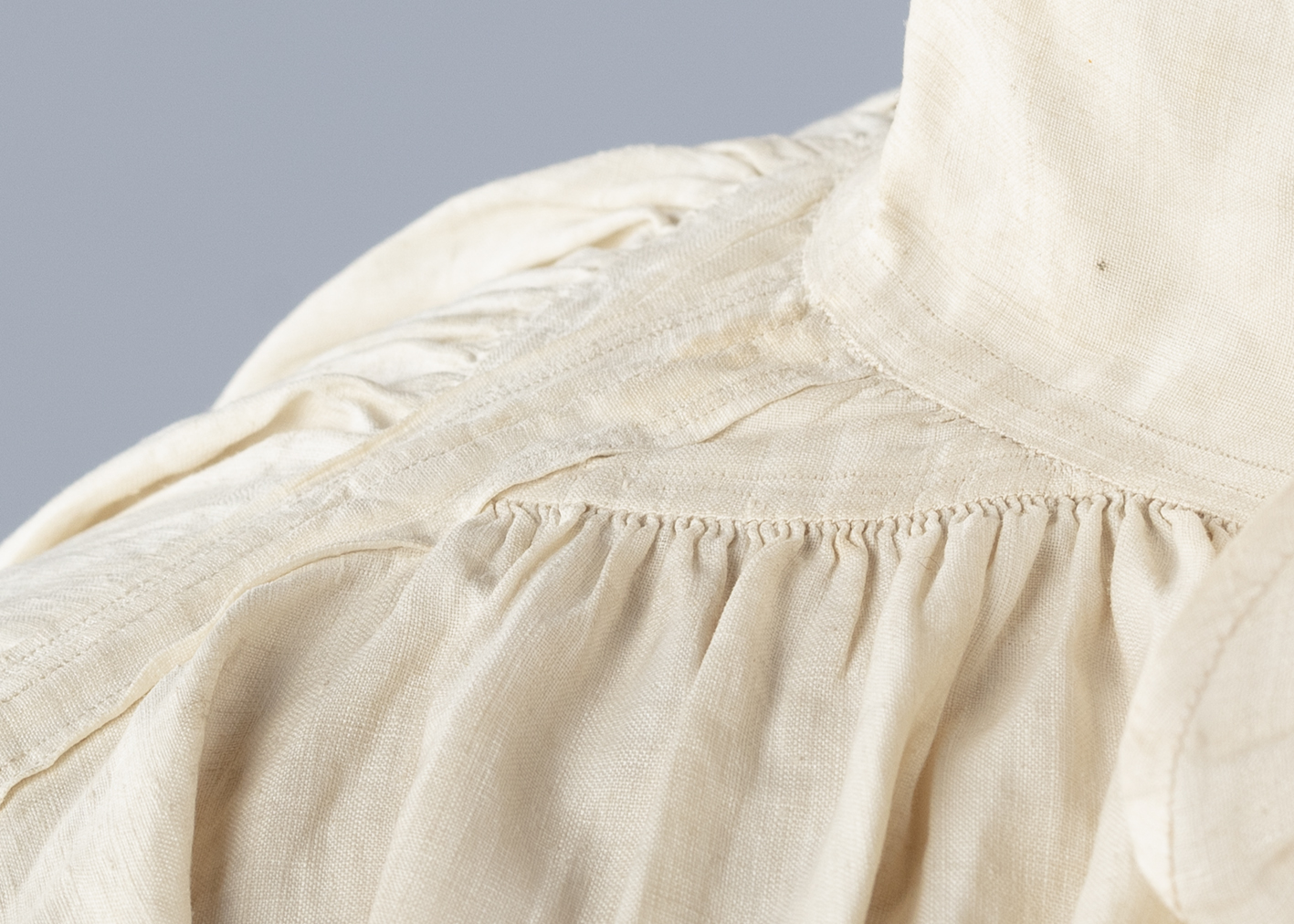
The millimetre-perfect hand stitching is exceptional on this linen shirt, [Fig.4] with the addition of excessively small stitch detailing around the neck and cuff edges. Construction is unique, utilising the delicate selvedge edges whipped together outwards up the side seams to create a small 1-2mm ridge. Other cut edges are joined with flat fell seams, barely 2-3mm wide. Although a gentleman would have owned many shirts for hygiene reasons, one practical necessity for the exemplary fine hand stitching was to help prevent seams from fraying during harsh hand laundering.
In the case of the Stephens shirt, it now has the natural ageing yellow of what was once bleached expensive high-quality linen, and though this garment shows minimal telling evidence of wear, such as relaxed buttonholes revealing use, it certainly seems to have been kept for ‘best’. It seems to have been saved from the vigorous actions required for maintaining cleanliness for regular wear, described by research professor in history at the University of Hertfordshire John Styles in his 2007 book on fashion in eighteenth century England, “The whitest, finest linens, such as lawn, cambric and Holland, were expensive. So too were the cleaning agents and hot water required to keep them pristine.” 14
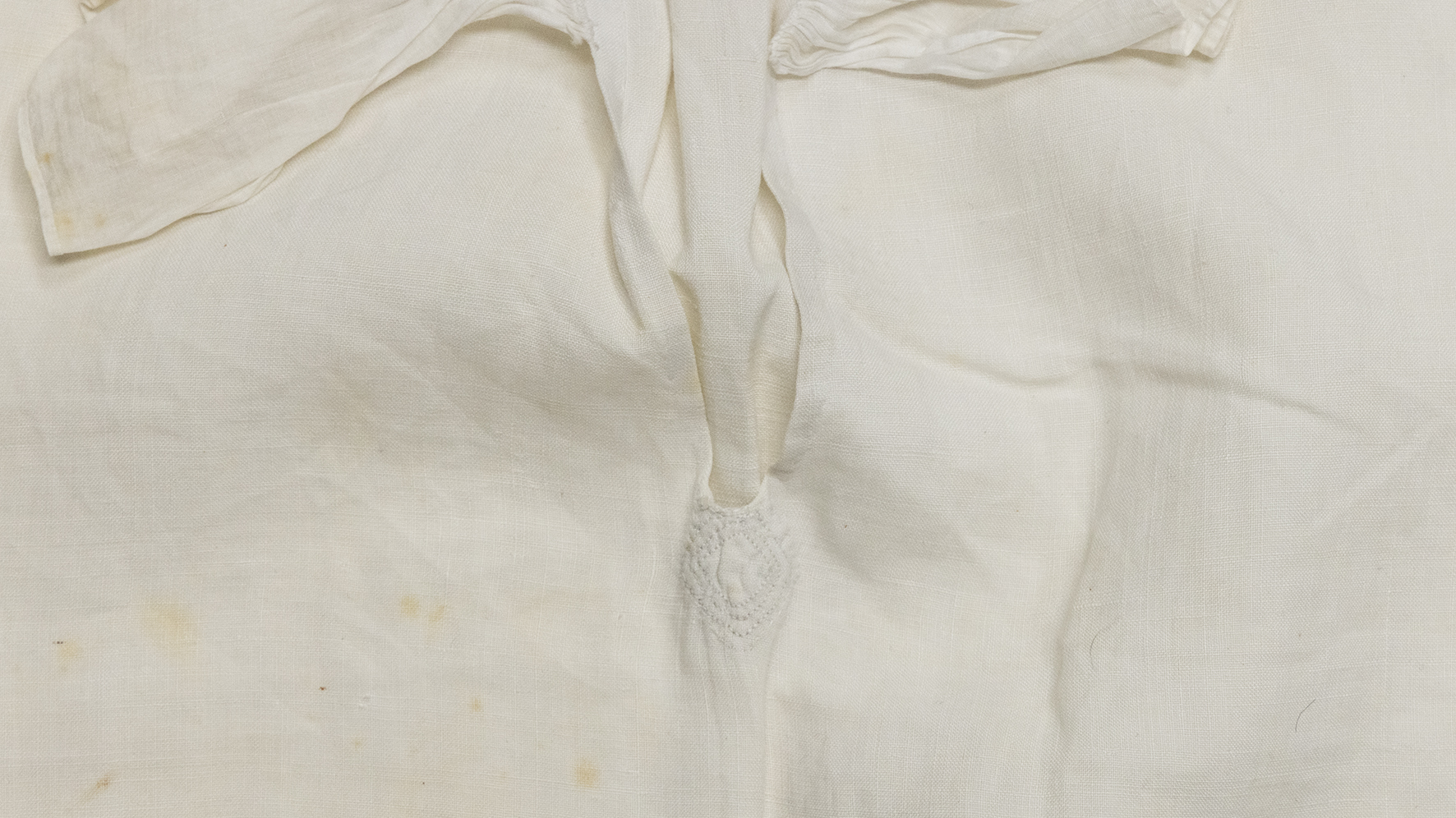
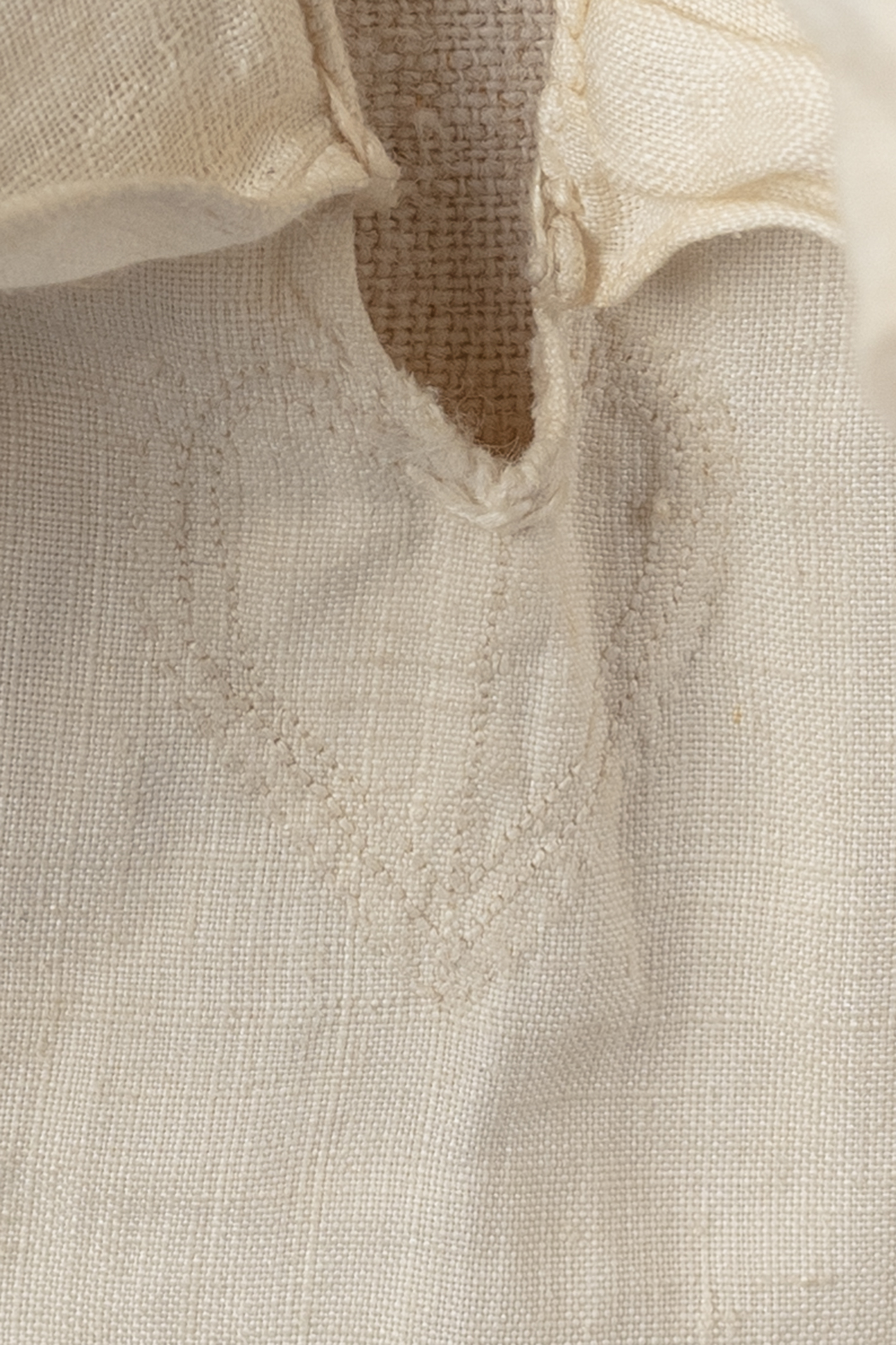
There are small areas of darning in the regions of the selvedges. However, these appear to be fabric weave repairs rather than garment repairs; the linen has a thread count of around 280–300, making the strands remarkably fine, and a loom width of 34 1/4” (880mm). Areas that require structural or aesthetic strength, such as around the armhole, collar, cuffs and side split gussets, have been double-layered. The slashed centre front neck opening is on either side adorned with fabric ruffles made from the same main garment linen, approximately 70mm wide by 700mm long, finely gathered into the 260mm openings. At the base of the centre front neck split, a double-rowed stitched heart shape with a central line reinforced with the addition of an internal patch.
The styling of a garment can change the way an observer perceives the wearer. Over the centuries, the shirt collar and centre front opening have developed into a significant feature of male dress which is evocative, becoming an area of appreciable detail as coats fell away, revealing the waistcoat with opened-up necklines. Commentary on this is recorded as early as 1710, in Steele’s ‘Beauty Unadorned’, as reported in the Tatler, in the spring of that year: “A sincere heart has not made half so many conquests as an open waistcoat”.15 The notion of romanticism leads quite beautifully to the aesthetic of period shirts for film and theatre, where the stylisation of the costume can evoke whole other centuries whilst still maintaining the feeling of the era in which it is grounded.
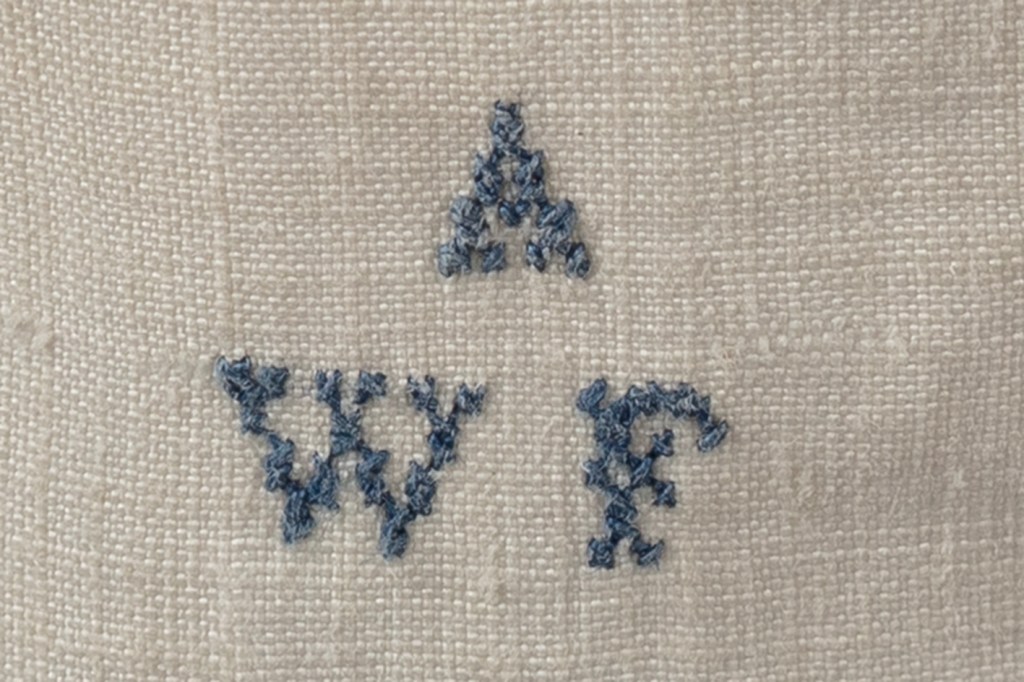
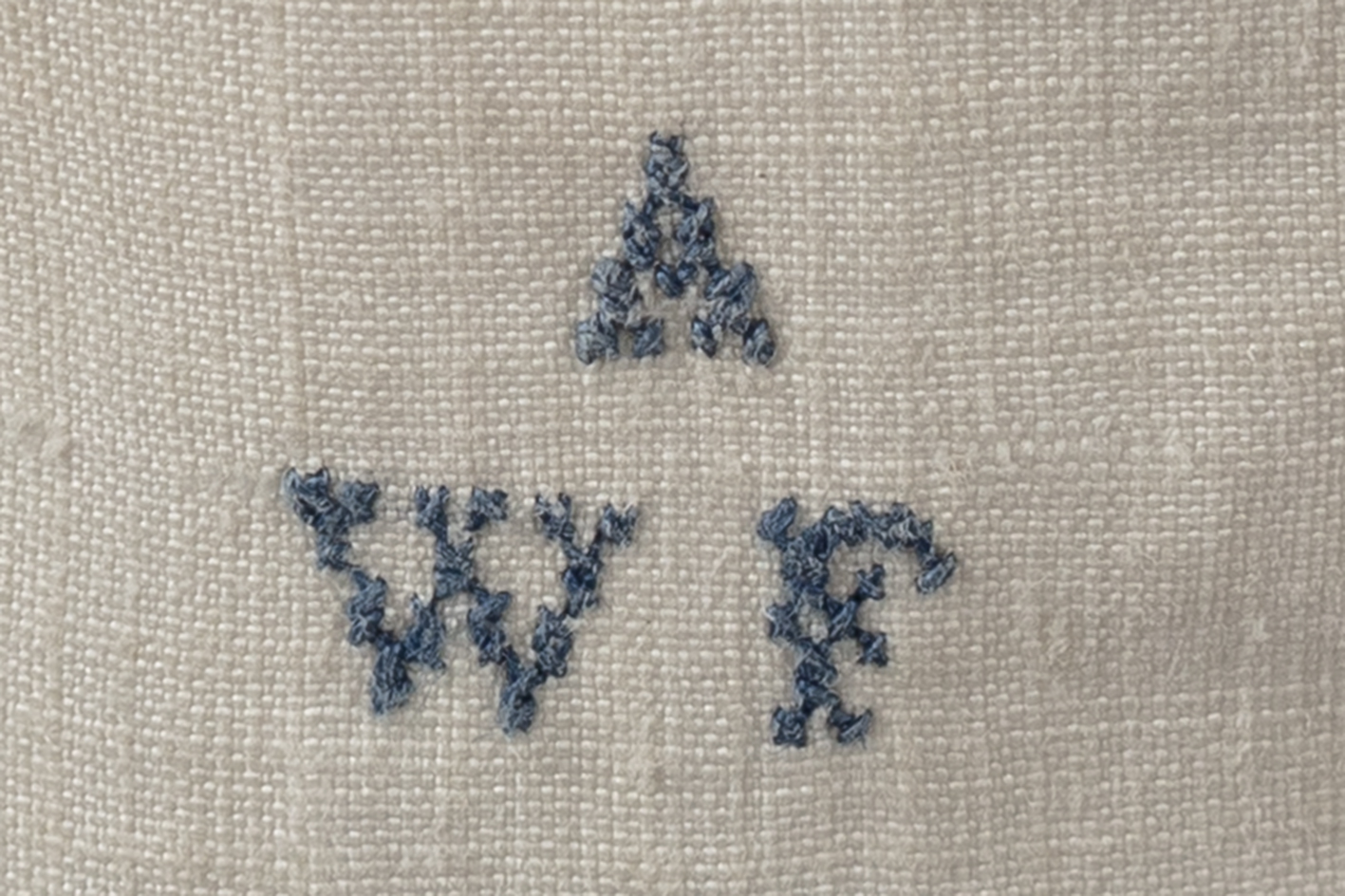
The last point of interest is a beautifully embroidered sky-blue silk laundry cross-stitched marker midway up the right-side split, AWF. One can only speculate what the initials AWF may stand for; in my romantic imagination, it is ‘Aldermaston William’s Finest!’ Of course, it will always be conjecture as to who the original owner of the shirt was. However, this heirloom was considered valuable, either for monetary or emotional reasons, and designated as important enough to be kept, treasured, and passed down through generations of one family. Connective social history can be rediscovered from diligent, informed research which brings forth these fascinating stories.
Reference List
1. C&TA. (n.d.). Geoffrey Squire Memorial Bursary Winner 2023. [online]. Available from:
https://www.ctacostume.org.uk/geoffrey-squire-bursary.html
2. Ancestry.com. (n.d.). Cora Milne Gow. [online]. Available from:
3. Auckland Museum. (n.d.) Shirt, Man’s [Stephens]. col.0989. [fabric]. [online]. Available from:
4. Ancestry.com. (n.d.). William Richard Wood Stephens. [online]. Available from:
https://www.ancestry.com.au/family-tree/person/tree/10486660/person/24099098202/facts
Hunt, W. (n.d.). Dictionary of National Biography, 1912 supplement/Stephens, William Richard Wood. [online]. Available from:
5. Ancestry.com. (n.d.). Charlotte Jane Hook. [online]. Available from:
https://www.ancestry.com.au/familytree/person/tree/10486660/person/309159501/facts
6. Ancestry.com. (n.d.). Charles Hook Stephens. [online]. Available from:
https://www.ancestry.com.au/family-tree/person/tree/38106556/person/120047459132/facts
7. Ancestry.com. (n.d.). Ina Winifred Gow. [online]. Available from:
https://www.ancestry.com.au/family-tree/person/tree/38106556/person/120047297858/facts
8. Remuera Heritage. (n.d.). RMS Remuera. [online]. Available from:
9. Ancestry.com. (n.d.). William Stephens (Jnr). [online]. Available from:
https://www.ancestry.com.au/family-tree/person/tree/16469794/person/29573332308/facts
10. The Berkshire Record Office. (n.d.). Aldermaston Brewery records. [online]. Available from:
http://ww2.berkshirenclosure.org.uk/CalmView/Record.aspx?src=CalmView.Catalog&id=DEX1668%2f3%2f5%2f9
11. Ancestry.com. (n.d.). William Stephens (Snr). [online]. Available from:
https://www.ancestry.com.au/family-tree/person/tree/16469794/person/20447656847/facts
12. Dorset Ancestors. (2010). The Dorset Button Industry. [online]. Available from: https://dorset-ancestors.com/?m=20100201
13. McDowell, A. (n.d.). The History of the Dorset Button Industry by Henry’s Buttons. [online]. Available from:
https://henrysbuttons.co.uk/history.html
14. Styles, J. (2007). The Dress of the People: Everyday Fashion in eighteenth-century England. New Haven: Yale University Press. Available from:
https://archive.org/details/dressofpeopleeve0000styl/page/40/mode/2up
15. Steele. (1710). The Tatler No 151. Tuesday, March 28, 1710. Beauty Unadorned. [online]. Available from:
100% Reverse Engineered Patterns of Original Garments
The Stephens and Cox/Bell shirts allowed me to delve deeper into the lesser-celebrated aspect of male clothing: undergarments. These particular specimens offer exquisite examples of eighteenth-century workmanship and were part of Hidden in the Archive’s broader research.
Why was the Stephens Shirt chosen to base the Context article upon? Of all the garments, from elegant suits to luxurious dresses, Stephen’s shirt was the one that evoked the most extraordinary emotional response within me. The combination of pure admiration for the constructional skills with expertly refined panache of the most delicate decorative stitching I have ever seen, whilst it also debunked methodologies of construction used for creating period shirts in the current day of French encased seams, as the seams were constructed of tiny 3mm selvedges and whipped together towards the outside.
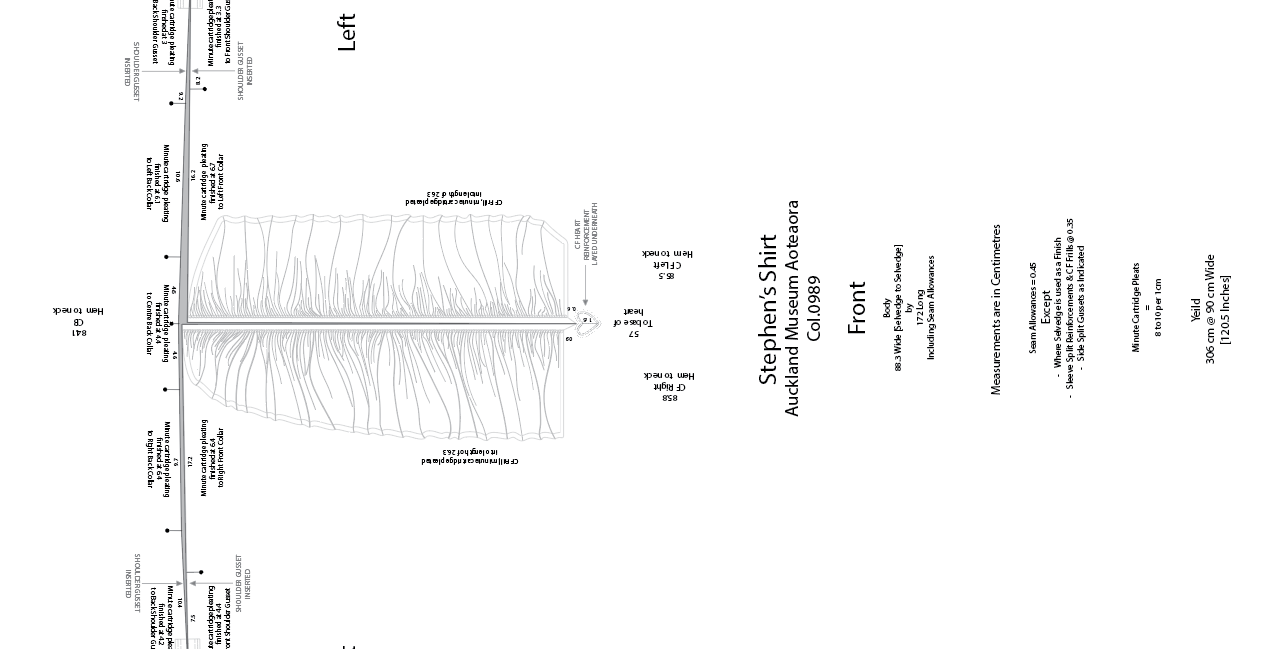
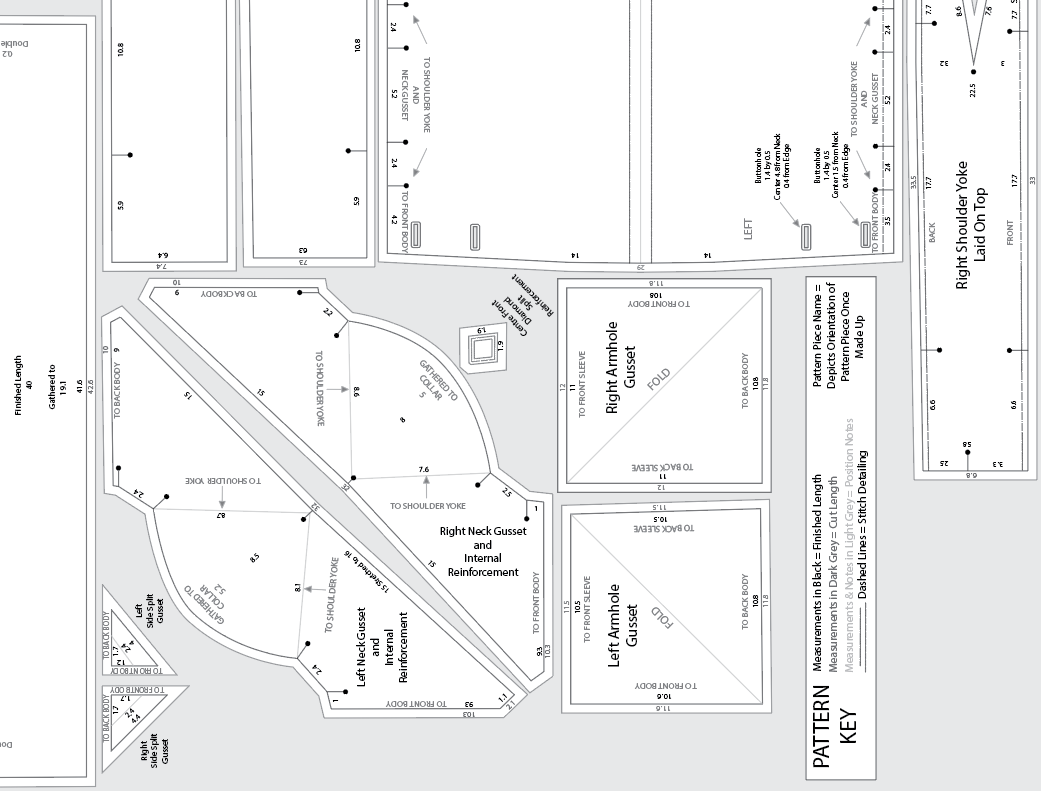
Of course, with all the theoretical research undertaken, it seemed a shame not to document the patterns for the Stephens and Cox/Gow shirts, not just for my records but with the view to make them publicly available and for sale.
By request via email to anna@annadeacon.com a 100% paper pattern, which can be either folded or rolled upon request, can be purchased, with a unique, password-protected QR code to link to detailed original artefact photographs, research and construction details. Providing detailed information in this way allows for the most explicit presentation, with the ability to zoom into images and provide hyper-links to other resources. Additionally the service of pattern grading can be undertaken, also reproduction private commissions, price upon request.
This QR system has also been applied to my website, http://www.annadeaconcouture.com, for research links for all of the other Hidden in the Archives research artefacts.
A world of possibilities